Most advice about food arrives dressed as a set of rules. Some foods are good, some are bad, and everything should be done in a way that fits a spreadsheet. Very few people keep that up for long, and very few need to.
The truth is more forgiving. Eating well is less about being perfect and more about making a few dependable choices so often that they become your default. Think of it as building a small set of habits that repeat, rather than attempting a single perfect week.
Start with what a normal day already gives you
Before changing anything, pay attention to what a typical day actually looks like. Most people are not eating badly because they lack willpower. They are eating that way because the quickest option is usually the most available one, and because shopping and cooking for a "healthy diet" sounds like a full-time job.
So start where you are. If breakfast is usually toast and coffee, keep the toast. Add something to it rather than replacing it — a boiled egg, some yoghurt, a handful of fruit. If lunch comes from the shop on a busy day, choose the option that includes something fresh rather than the one that is only quick.
Change that is additive tends to survive. Change that is subtractive tends to last about a fortnight.
Build meals around a simple shape
You do not need a nutrition app to do this. A useful pattern is to aim for something from each of these groups at most meals:
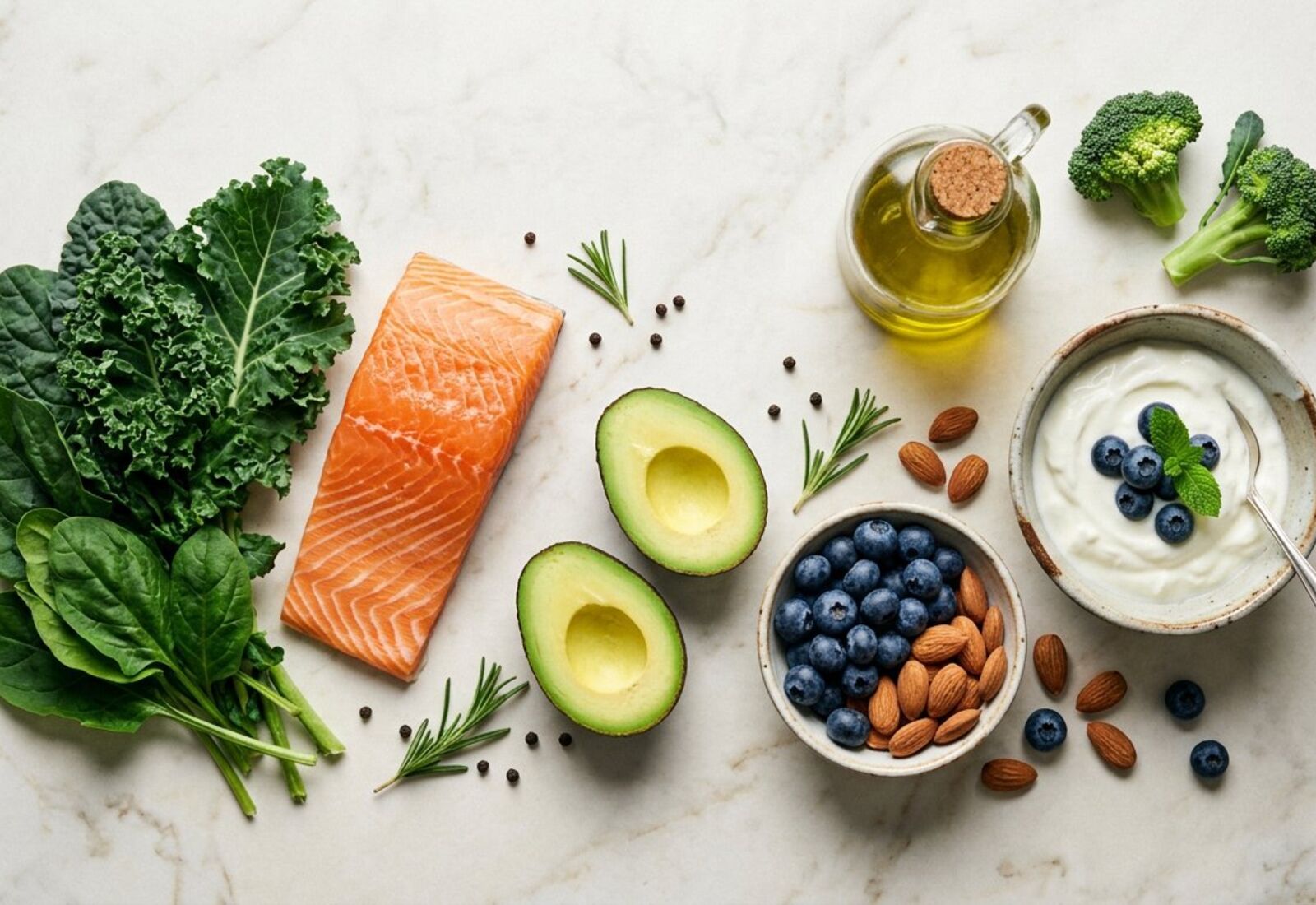
- A protein — eggs, dairy, beans, lentils, fish, poultry, tofu or meat
- Vegetables or fruit — ideally more than one colour across the day
- Something with fibre — oats, wholegrains, beans, nuts, seeds, wholegrain bread
- A source of fat — olive oil, nuts, seeds, avocado
That is it. If a plate contains those ingredients in rough proportion, it is almost certainly a good meal — regardless of whether anyone calls it a particular diet.
You do not need a perfect plate. You need a repeatable one, most days of the week, that you actually enjoy eating.
Let fibre do more of the work
Fibre is the most overlooked part of everyday eating, and the one that helps with the most: energy, fullness, digestion, blood sugar and cholesterol. It is also the easiest thing to increase without adding much effort.
Try adding a source of fibre to meals you already eat — beans into a Bolognese, oats into a porridge, nuts into a yoghurt bowl, wholegrain bread instead of white, seeds into a salad. Increase gradually and drink enough water, because your digestion needs time to adjust.
Be suspicious of anything that says "never"
Foods framed as a permanent threat — never eat carbs, never skip breakfast, never eat after a certain hour — tend to produce the same result: a short period of strictness followed by a rebound and a sense of personal failure.
A more useful question is: what does this food do in my body, and how often am I having it? Occasional cake is not the problem. Only cake is. That shift in thinking removes a surprising amount of stress from eating, and stress is often a bigger obstacle than the food itself.
What about the things that feel genuinely hard
A few questions come up repeatedly in our nutrition consultations, and they deserve honest answers:
What if I am always tired in the afternoon?
Long gaps between meals, a heavy lunch and too little fluid are the usual suspects. A protein- and fibre-containing lunch, a glass of water, and a short walk can be more effective than anything you add as a supplement. If fatigue is persistent, unexplained or affecting your daily life, it should be assessed rather than dialled away with a diet change.
What if I struggle with hunger?
Constant hunger usually points to meals that are missing protein or fibre, or to too much restriction during the day followed by eating in the evening. Adding volume — vegetables, legumes, wholegrains — and including protein at breakfast often reduces the number of times you need to think about food at all.
What if eating out is most of my week?
Order the same as you would at home, just from a menu. Look for a protein, something green, and a side that is not fried. You do not need a separate "cheat" day; the pattern across a week matters far more than any single meal.
One small step to start this week
Pick one change and make it automatic rather than heroic. Add a vegetable to one meal a day. Swap one refined carbohydrate for a wholegrain version. Keep a glass of water on the desk. When a change becomes unremarkable, add the next one.
Consistency built this way is slower at the start and considerably faster in the long run, and it is the approach we use in every nutrition consultation here at Healthy Solution Point — small, specific, and built around food you already like.
A note from our nutrition team
If you are managing diabetes, a food allergy, an eating disorder history, kidney disease or any other condition where diet is medical, please speak to your clinician before making significant changes. Our nutrition service is happy to work alongside your existing care.